
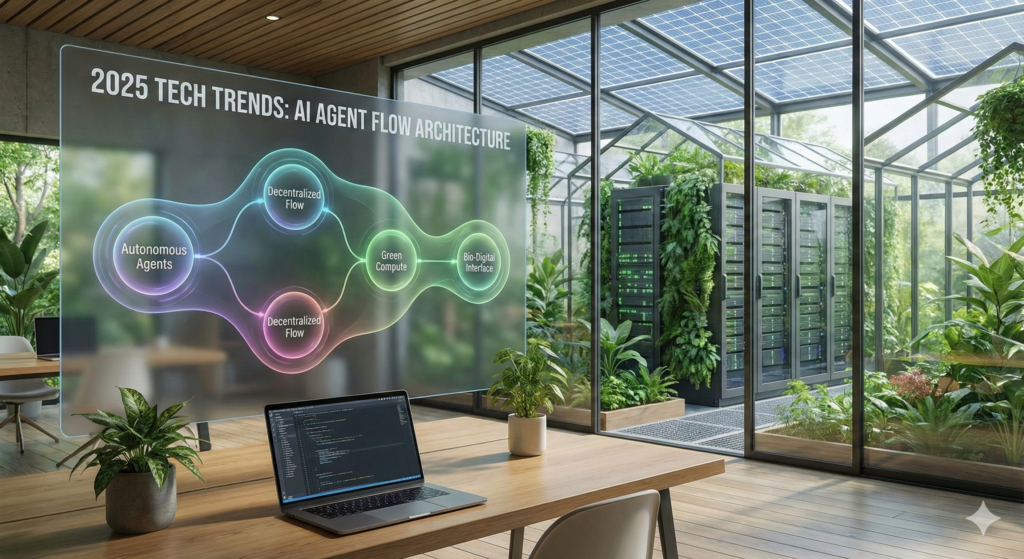
Introduction: The “Demo Phase” is Over
If 2024 was the year of the “AI Demo,” 2025 is the year of “AI Engineering.” We have moved past the novelty of chatting with a bot. The 2025 tech trends dominating the landscape are no longer about generating text; they are about generating action.
For business leaders and developers, the ground has shifted. The “Vibe Coding” techniques that worked six months ago are now creating technical debt. The manual copy-pasting of prompts is being replaced by robust API integrations. And standard SEO research is being upended by “Time-Test Diffusion” algorithms.
At SyntorIT, we have analyzed the global market shifts of December 2025 to bring you this definitive guide. Whether you are looking for (https://www.syntorit.com/services/web-development) solutions or strategic (https://www.syntorit.com/services/devops-consulting), this report outlines the exact technologies that will define your survival in the coming year. (syntorit.com/2025-tech-trends-agents-vibe-coding)
Chapter 1: Vibe Coding is Dead. Long Live Flow Architecture.
The Trap of “Vibe Coding”
In early 2025, a concept known as “Vibe Coding” went viral. Popularized by Andrej Karpathy, it was the idea that “English is the hottest new programming language.” You could simply “vibe” with an LLM—typing loose, natural language instructions—and it would spit out a functioning app.
It sounded perfect. It was also a trap.
As we close the year, we are seeing the “Vibe Coding Hangover.” While excellent for prototypes, this method fails catastrophically at scale. Why? Because LLMs are probabilistic, not deterministic. When you ask an AI to “fix the login bug” without strict context, it might rewrite your entire authentication logic, breaking your database connections in the process.
The Shift to Context Engineering & Flow Architecture
The industry is pivoting to a disciplined methodology known as Flow Architecture (or Context Engineering). This isn’t about blind prompting; it is about architecting a rigid system where AI is just one component.
-
- The Old Way (Vibe Coding): Asking ChatGPT to “write a payment function.”
-
- The New Way (Flow Architecture): Designing a state machine where:
-
- Agent A drafts the code based on strict documentation.
-
- Agent B (the Critic) reviews the code for security vulnerabilities.
-
- Agent C writes the unit tests.
-
- A human (https://www.syntorit.com/services/backend-developer) conducts the final review.
-
- The New Way (Flow Architecture): Designing a state machine where:
Key Takeaway: You cannot build an enterprise platform on “vibes.” You need a partner who understands (https://www.syntorit.com/services/mobile-app-development) architecture to ensure your AI-generated code is secure, maintainable, and scalable.
Chapter 2: Stop Using ChatGPT (Start Building APIs)
You Are Stuck in “Manual Mode”
Are you still opening ChatGPT, pasting in a customer email, asking for a draft, copying the result, and pasting it into Outlook?
If so, you are treating the most powerful technology of our generation like a typewriter. This is the “Interface Trap.” The chat box you use is just a demo; the real product is the API (Application Programming Interface).
The Power of “Headless” AI
One of the most actionable 2025 tech trends is the move to “Headless AI” via Integration with third-party services and APIs. By bypassing the chat interface and connecting directly to the model via code, we can build custom tools that solve specific business problems automatically.
3 Tools SyntorIT Can Build for You Today:
-
- The Email Triage Bot:
-
- How it works: We connect the OpenAI or Anthropic API directly to your company’s Outlook server.
-
- The Result: It reads every incoming email, tags it (e.g., “Urgent,” “Invoice,” “Spam”), drafts a reply based on your company’s tone guidelines, and saves it as a draft. You just click “Send.”
-
- The Email Triage Bot:
-
- The “Talk to Your Data” Portal:
-
- How it works: We index your thousands of PDF contracts and technical manuals into a Vector Database.
-
- The Result: Your employees can ask, “What is the warranty policy for Product X?” and get an instant answer with citations, without ever opening a file.
-
- The “Talk to Your Data” Portal:
-
- The Intelligent Data Cleaner:
-
- How it works: Drag a messy Excel file into a custom web portal.
-
- The Result: The API formats, standardizes, and error-checks the data instantly, ready for your (https://www.syntorit.com/services/ecommerce) platform.
-
- The Intelligent Data Cleaner:
Chapter 3: The Agentic Workforce & LangGraph
Chatbots are Toys. Agents are Employees.
For the last two years, we have treated AI like a smart encyclopedia. You ask a question; it gives an answer. In late 2025, that model is obsolete. We are entering the era of the Agentic Workforce.
The distinction is simple: Chatbots talk. Agents do.
The Technology: LangGraph
The tool driving this revolution is LangGraph. It allows our (https://www.syntorit.com/services/devops-consulting) teams to build “loops” of reasoning. Unlike a linear script, a LangGraph agent can self-correct.
The “Self-Correction” Loop:
-
- Plan: The Agent analyzes a request (e.g., “Refund order #1234”).
-
- Act: It attempts to log into the Stripe API.
-
- Observe: It sees an error message (“Login Failed”).
-
- Correct: Crucially, instead of giving up, it analyzes the error, realizes its token expired, refreshes the token, and tries again.
Deploying Your First Digital Worker
This technology allows us to build “Digital Employees” for your business. Imagine a “QA Agent” that automatically tests every button on your website every night at 3 AM and reports bugs to your Slack channel. This is not sci-fi; it is the standard for 2025. However, it requires a “Zero Trust” security environment—something our (https://www.syntorit.com/services/vpn-app) experts specialize in securing.
Chapter 4: The Deep Research Revolution (Time-Test Diffusion)
40 Hours of Work in 4 Minutes
The final pillar of our 2025 tech trends report concerns information gathering. A new class of AI models, known as “Deep Researchers,” has emerged, capable of performing weeks of market analysis in minutes.
The breakthrough technology is called Time-Test Diffusion (TTD-DR).
How TTD-DR Changes SEO
Traditional AI searches Google once and summarizes the first result. TTD-DR operates like a human Ph.D. researcher.
-
- The Draft: It writes a “noisy,” imperfect first draft of the report.
-
- The Critique: It reads its own draft and identifies missing data (e.g., “I need 2025 statistics for Q3”).
-
- The Diffusion: It performs targeted follow-up searches to “denoise” the report, refining it iteratively until it is accurate.
For an (https://www.syntorit.com/services/seo), this changes everything. We can now map every keyword gap of your top 50 competitors instantly. We can generate topic clusters based on real-time user sentiment analysis rather than outdated search volume metrics.
Conclusion: Don’t Just Watch the Trends—Build Them
The 2025 tech trends outlined here—Flow Architecture, API Integration, Agentic Workflows, and Deep Research—are not distant futures. They are the current reality. Companies that cling to “Vibe Coding” and manual workflows will find themselves outpaced by competitors running Agentic systems.
At SyntorIT, we are more than just a service provider; we are your partners in this transition. Whether you need to modernize your legacy code or build a futuristic (https://www.syntorit.com/services/lms-web-design), our team is ready.
Are you ready to stop vibing and start engineering? (https://www.syntorit.com/contact) for a free consultation.